
Overview
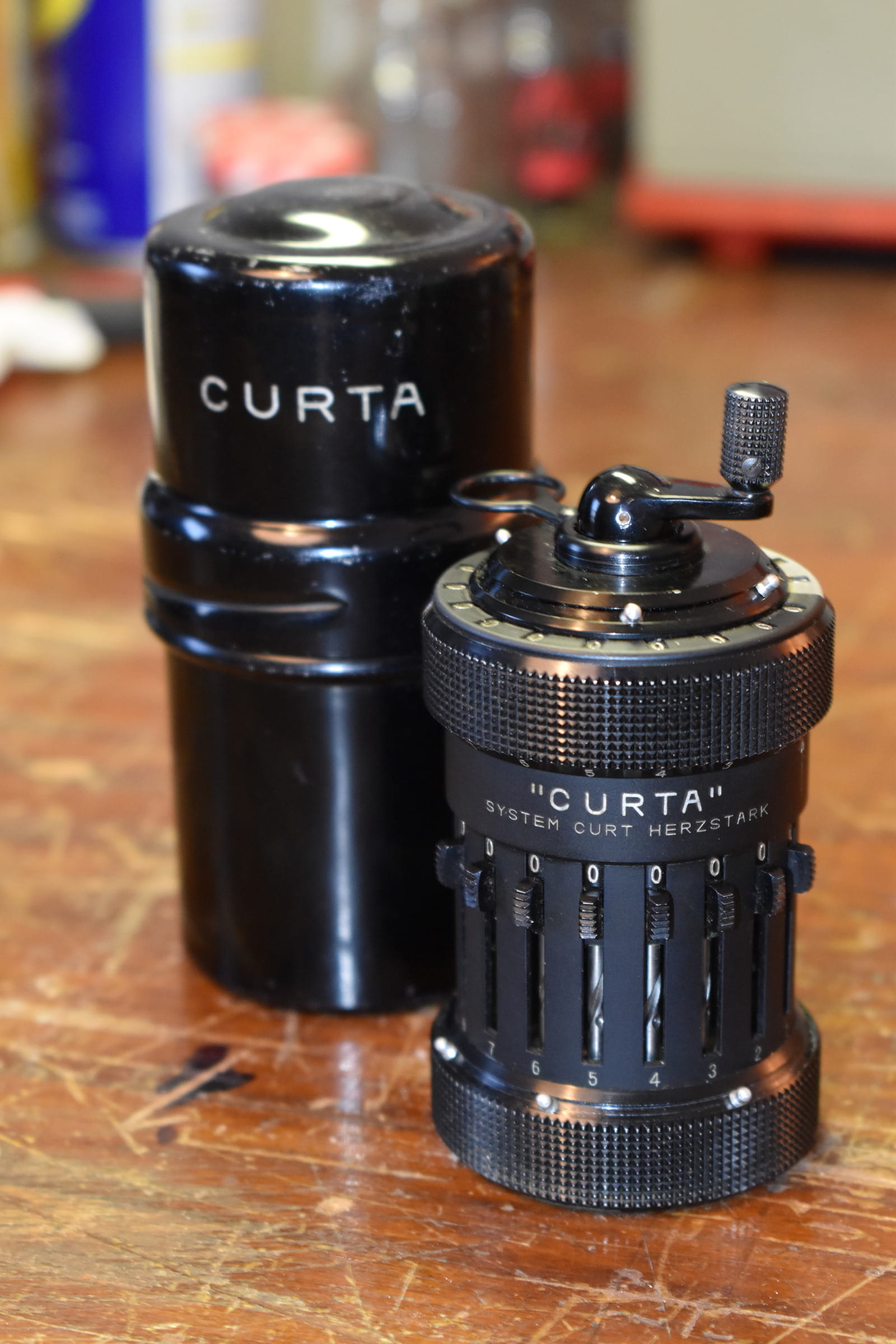
The Curta is very different from most other mechanical calculators. It’s not electric, the hand crank is mounted on the top of the cylindrical device, the input is below it, and it can be easily held in a single hand!
The Curta was originally designed by an Austrian engineer in the 1930s named Curt Herzstark - the son of a Jewish father and Catholic mother. He filed a patent for a unique and compact single-stepped drum mechanism for a mechanical calculator in 1938. Later that year, he was forced to work for the Nazis developing precision instruments for the German army.
Eventually, due to his heritage, Herzstark was sent to Buchenwald concentration camp in 1943. He was able to use his knowledge and plans for a small calculating machine as a bargaining chip with the head of the camp work department. Herzstark was allowed to continue his work on designing a calculating machine with the caveat of it being a gift for the Führer when it was completed. However, the camp was liberated on April 11th, 1945. Later that same year Herzstark had a factory setup and was producing prototype machines.
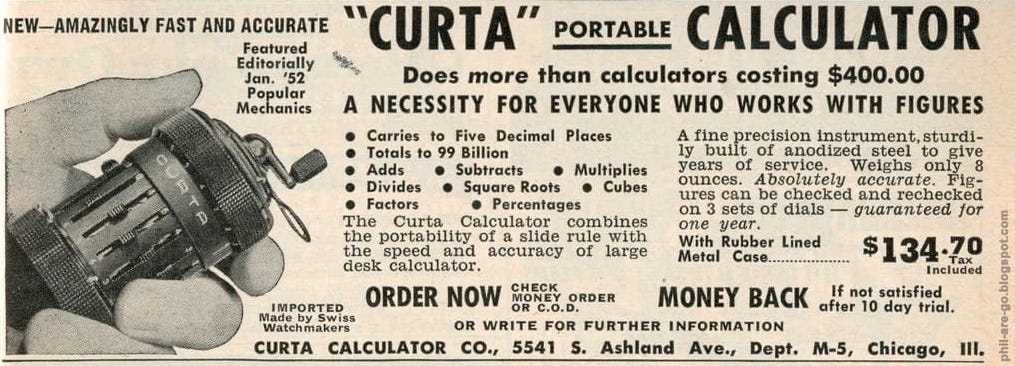
Full production for commercial Curta machines began in 1947 with the ‘Type 1’, and then a second upgraded ‘Type 2’ model began production in 1953. The Type 1 originally sold for $125 ($1,547.80 in 2025). Around 80,000 Type I Curtas were produced and 60,000 Type II machines were produced. The Curta was considered to be the best portable calculator and was manufactured until the 1970s when it started to be replaced by electronic calculators. However, even after the electronic calculator became widespread, Curtas were still used in rally racing due to early electronic calculators not faring well with the constant bounces and jolts of rallying.
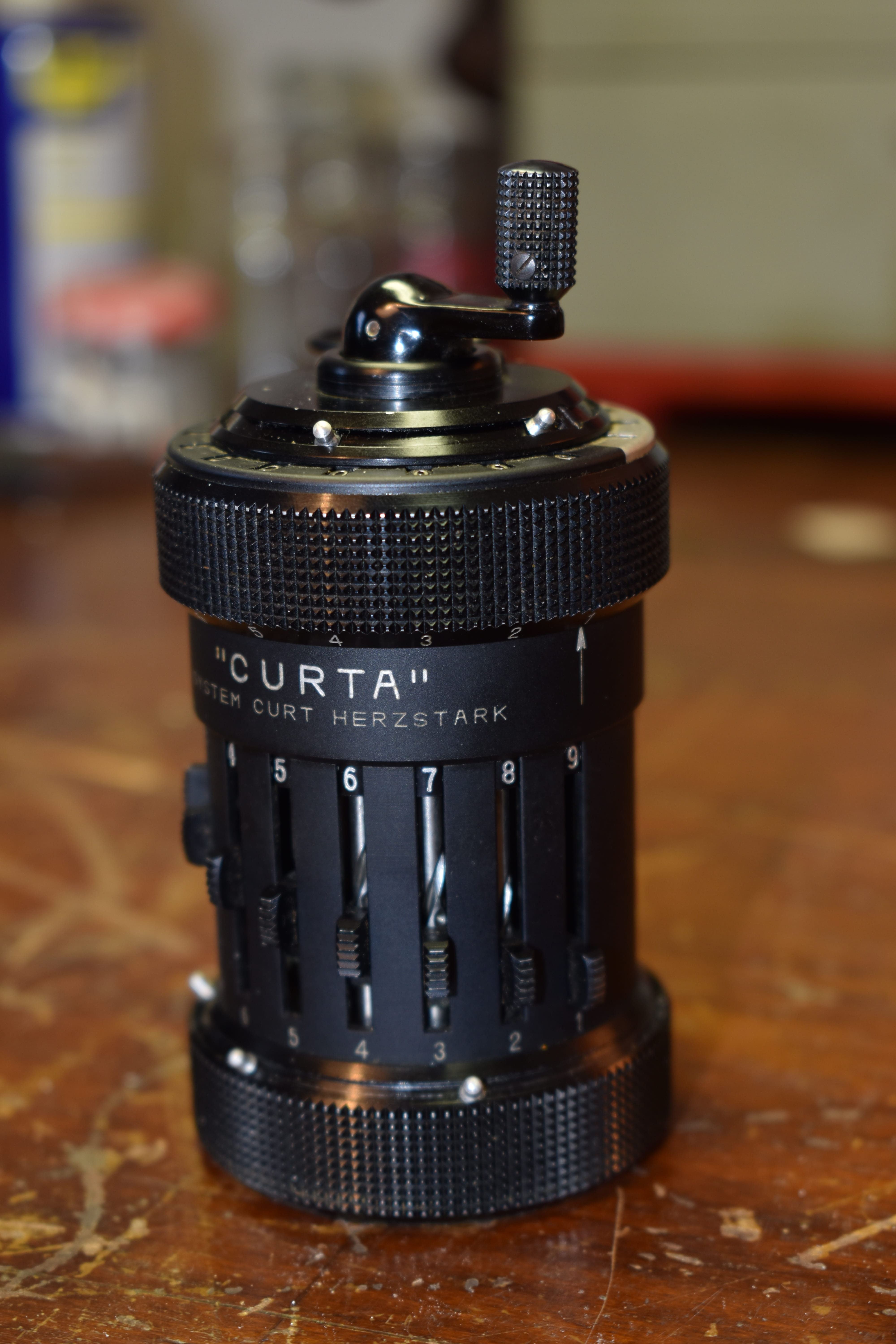
This Curta is a Type 1, Serial #7251 - a semi-prime serial number! It was built in January of 1951. This machine has narrow rectangular entry knobs with teeth. It also has the rounded metal top handle without an arrow, grey stripe for subtraction, and clockwise opening canister.
Controls
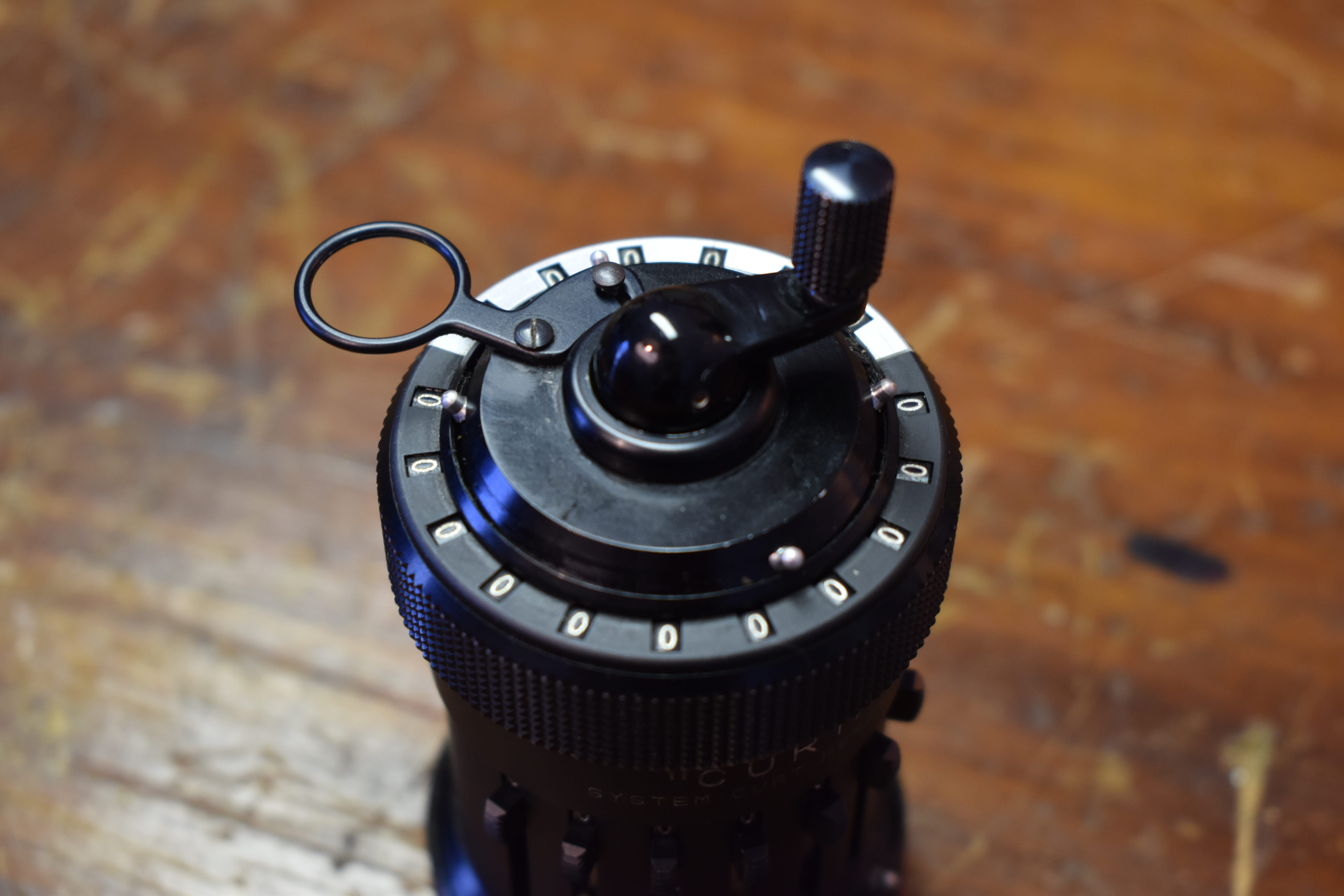
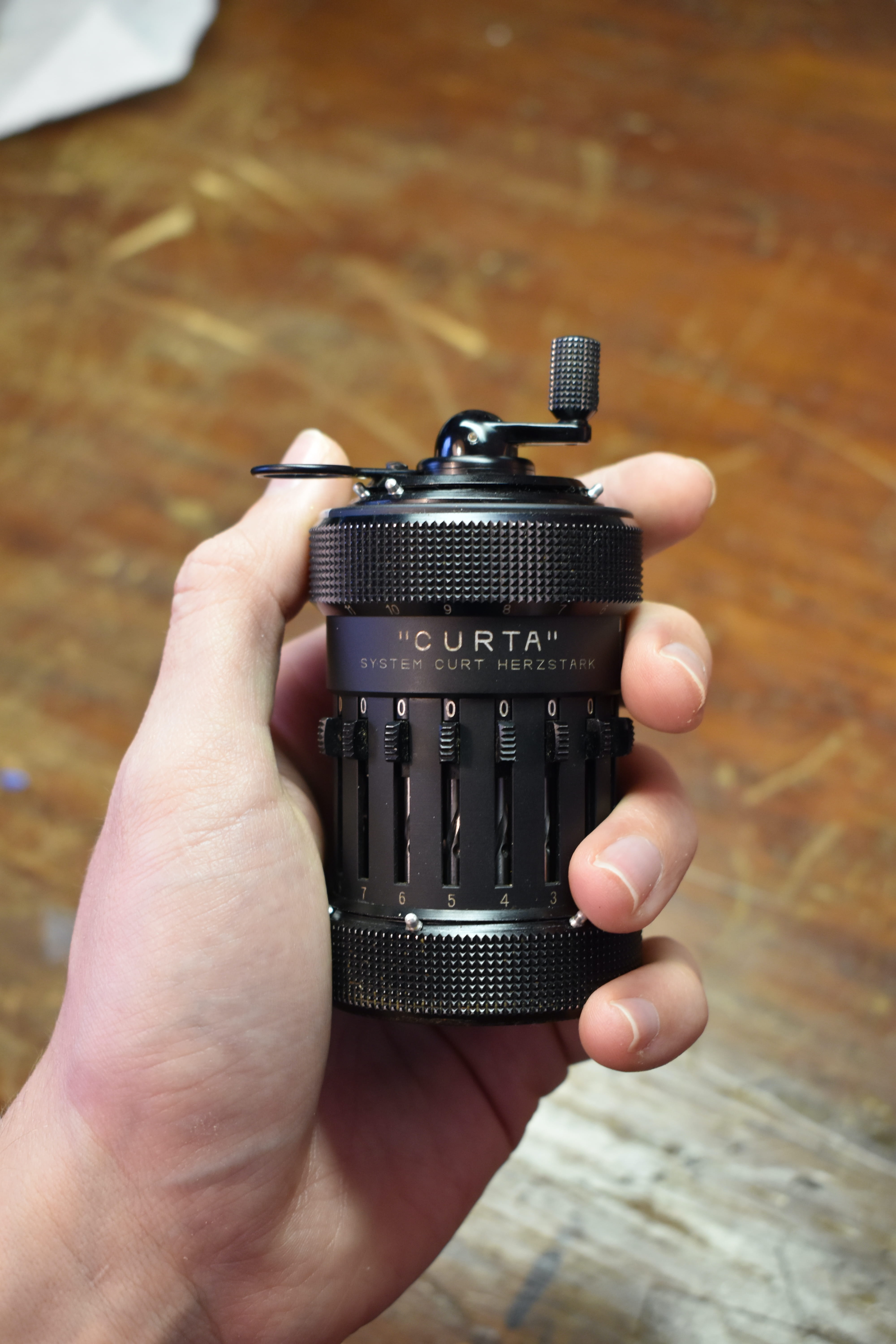
The main operating handle on the Curta is mounted vertically on the top of the machine. It rotates clockwise to perform an addition operation. The handle can be pulled upward revealing a small grey ring. This indicates that cranking the hand clockwise now performs a subtraction instead of an addition operation.
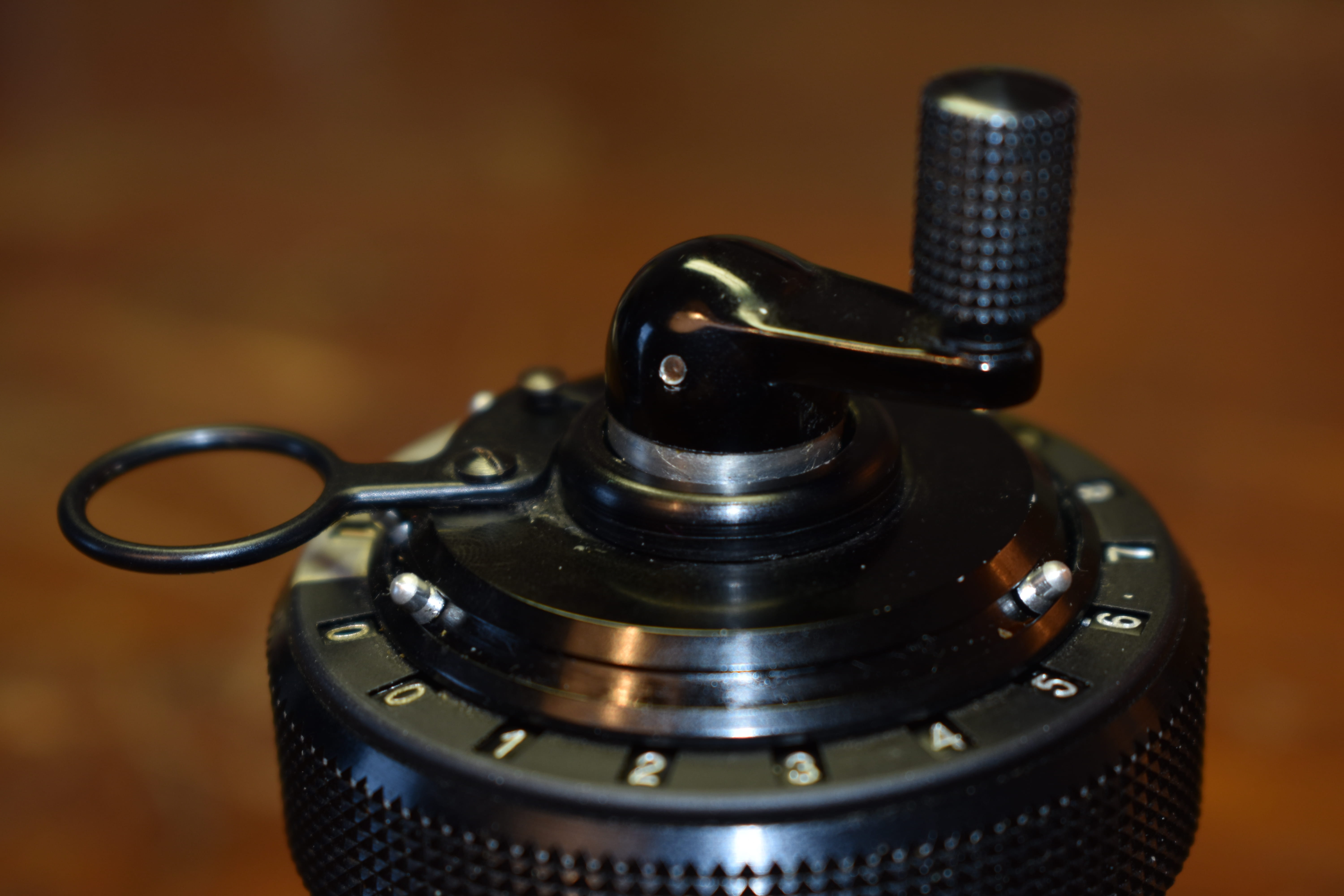
Just below this is the clearing lever. It can be folded for storage in the canister by pressing down the small pin beside the handle.
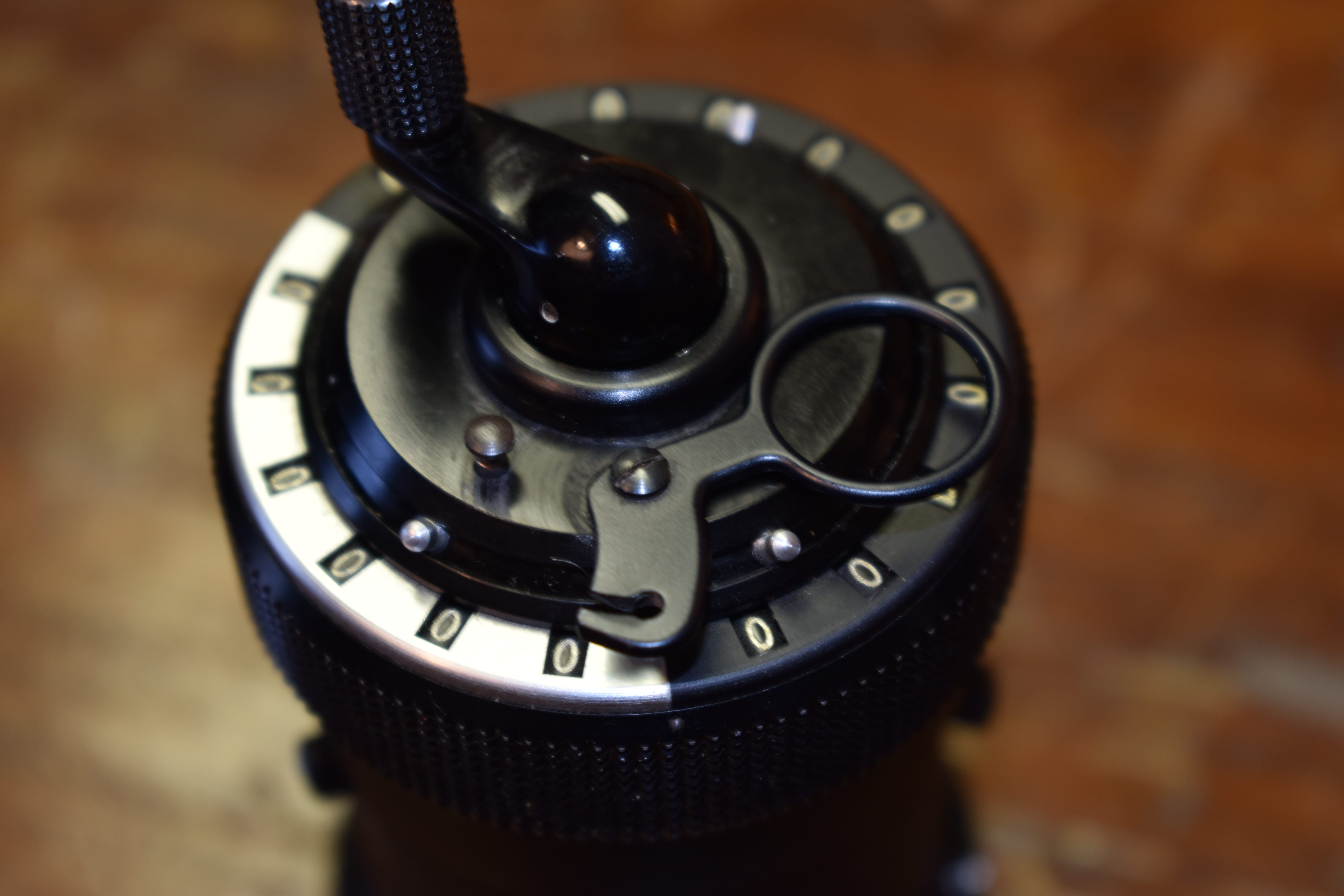
The clearing lever can be folded out and locked into place for normal operation. Rotating the clearing handle clears out the result and counter register. You can also rotate it halfway to only clear one of the registers.
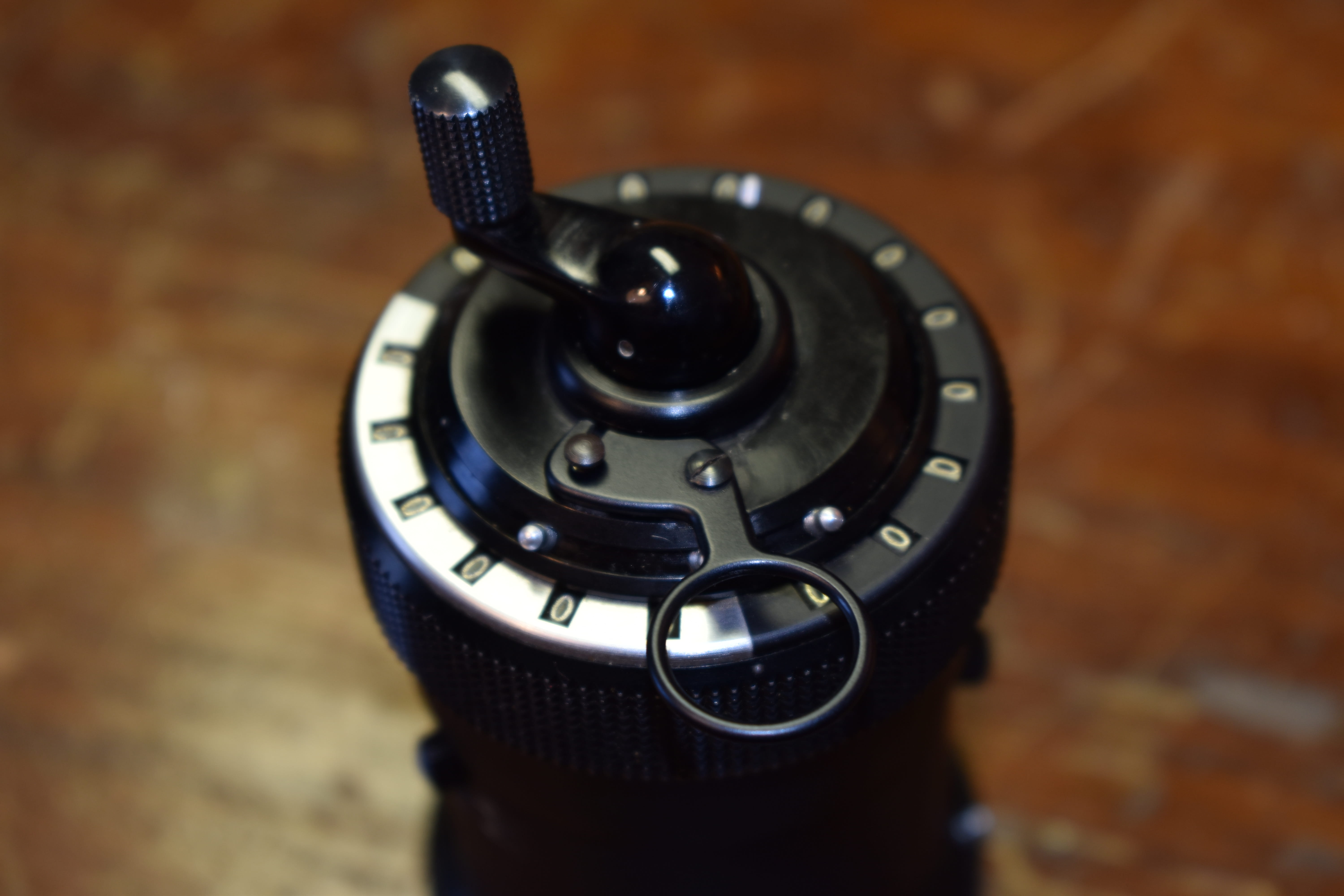
Below this is the display for the calculator’s output registers. The primary 11 digit result register is on the black side, and the 6 digit counter register is on the silver side. There also several silver decimal markers that can be slid around above the registers. This whole upper carriage assembly can be lifted up and rotated left and right in order to change to counter and result register positions in relation to the input register.
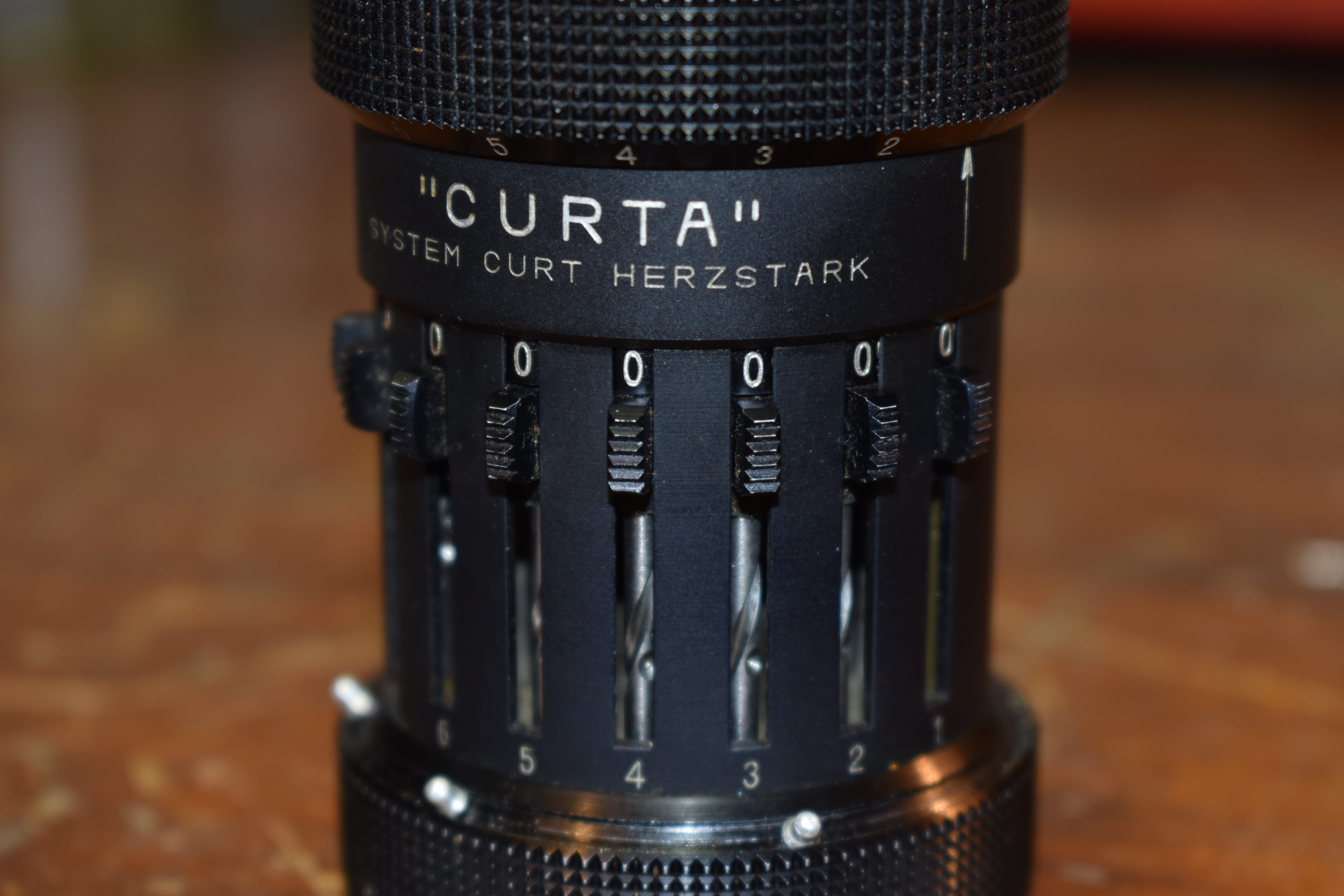
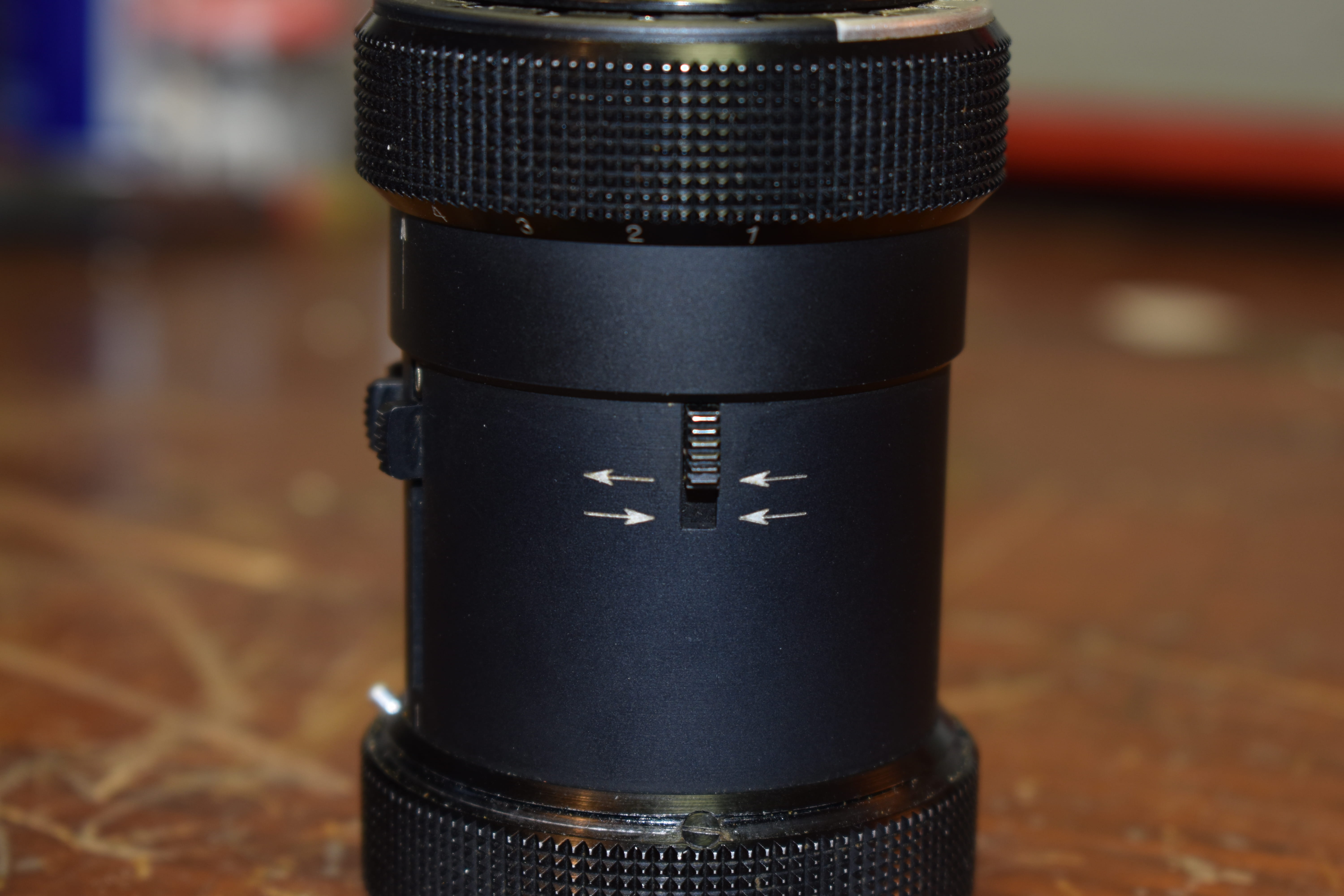
There is an arrow above the rightmost input slider pointing at the current result register place value. There are a total of 8 input sliders with dials above them showing the current value for that column. There are numbers for each column and more silver decimal markers below that. And finally, on the side of the machine is a switch for reversing the direction of the counter mechanism.
Canister
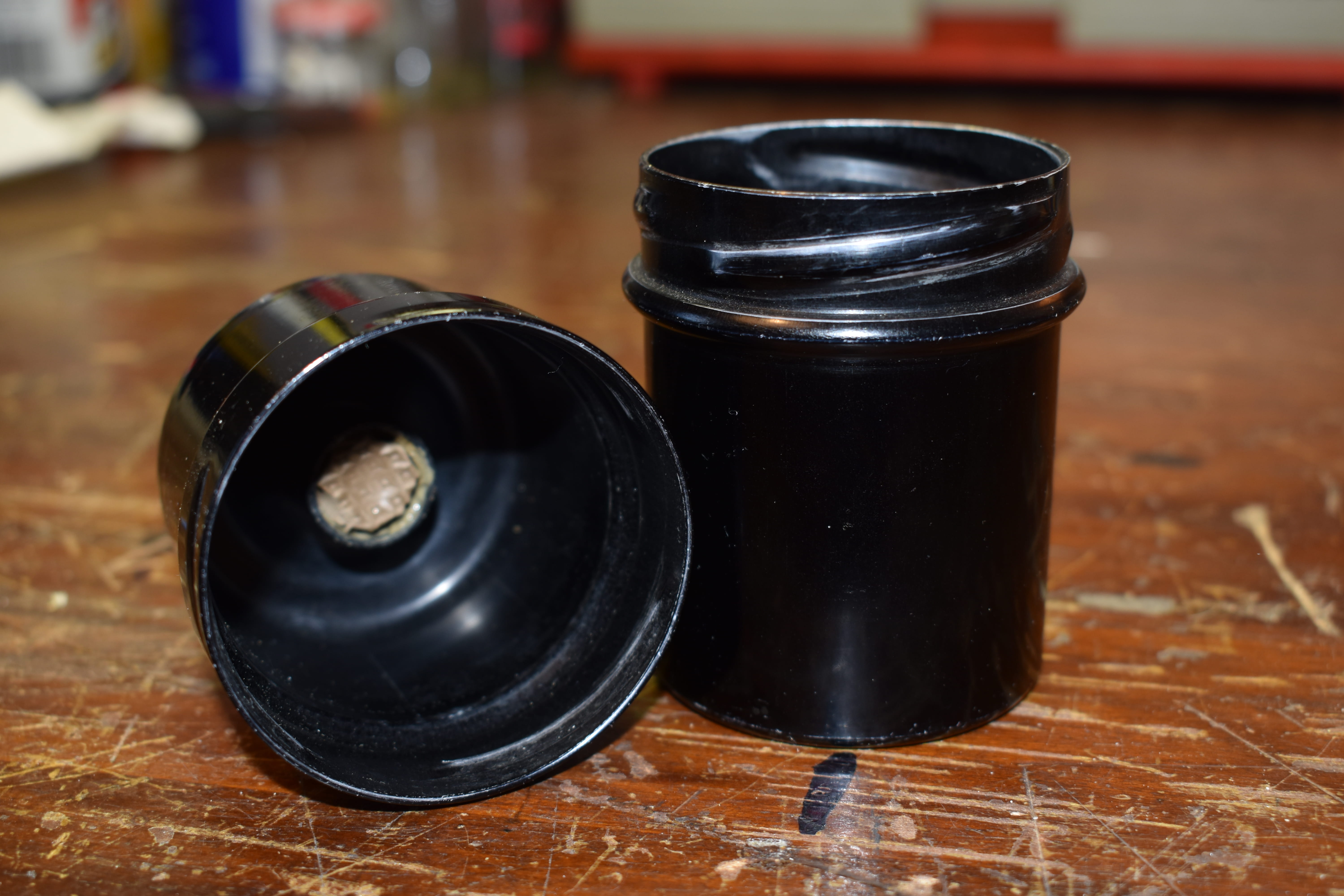
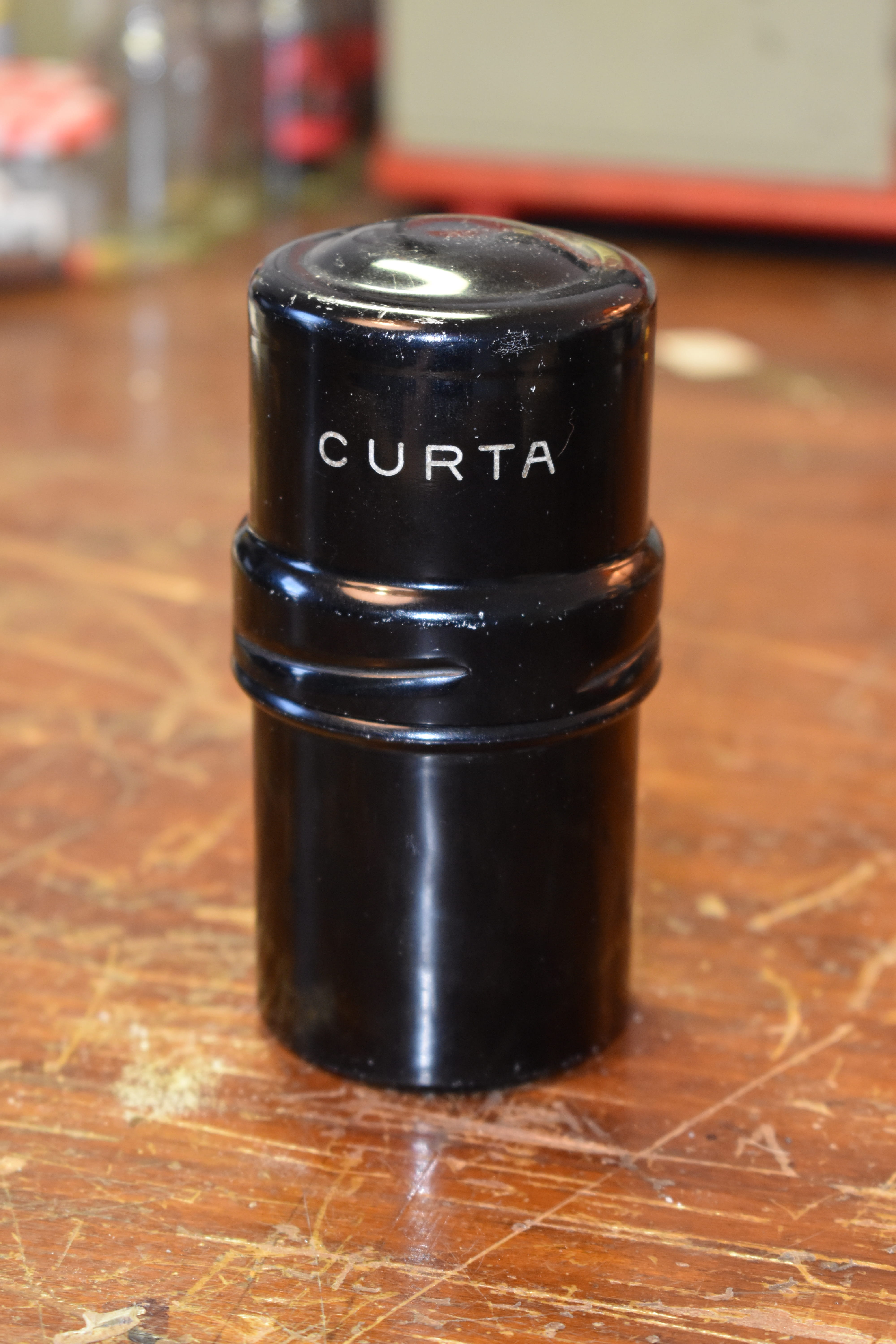
The canister is rather simple. It is metal and opens clockwise. In the lid there is a rubber insert that acts as a cushion and applies pressure on the Curta handle to ensure it doesn’t rattle around in the canister. The rubber insert is currently trying to turn back into a liquid, so it will be replaced shortly.
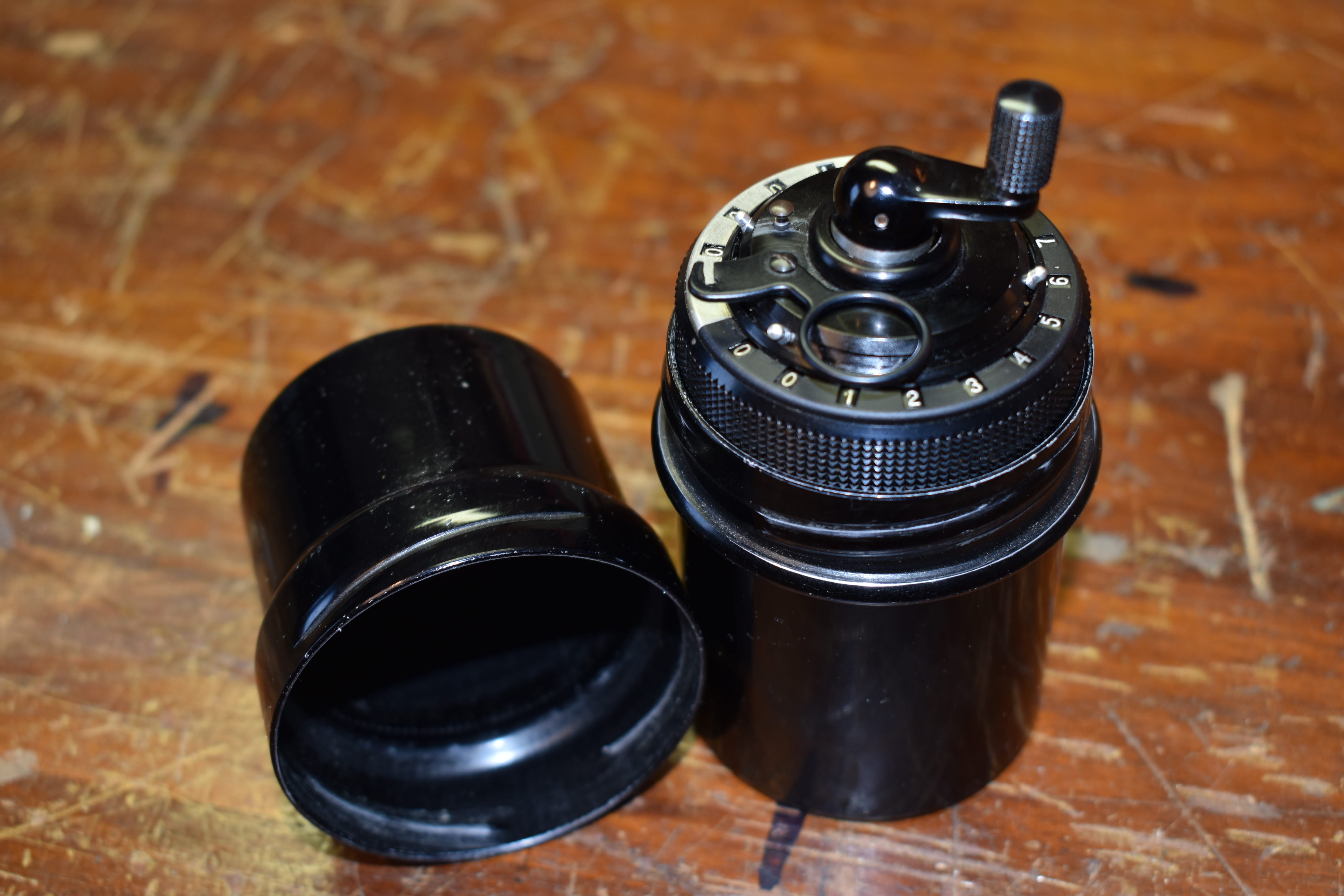
With the lid screwed on tightly, the Curta inside cannot be felt rattling or jostling around at all. And it’s still easily portable!
Manuals
This machine also came with two original booklets when I received it.
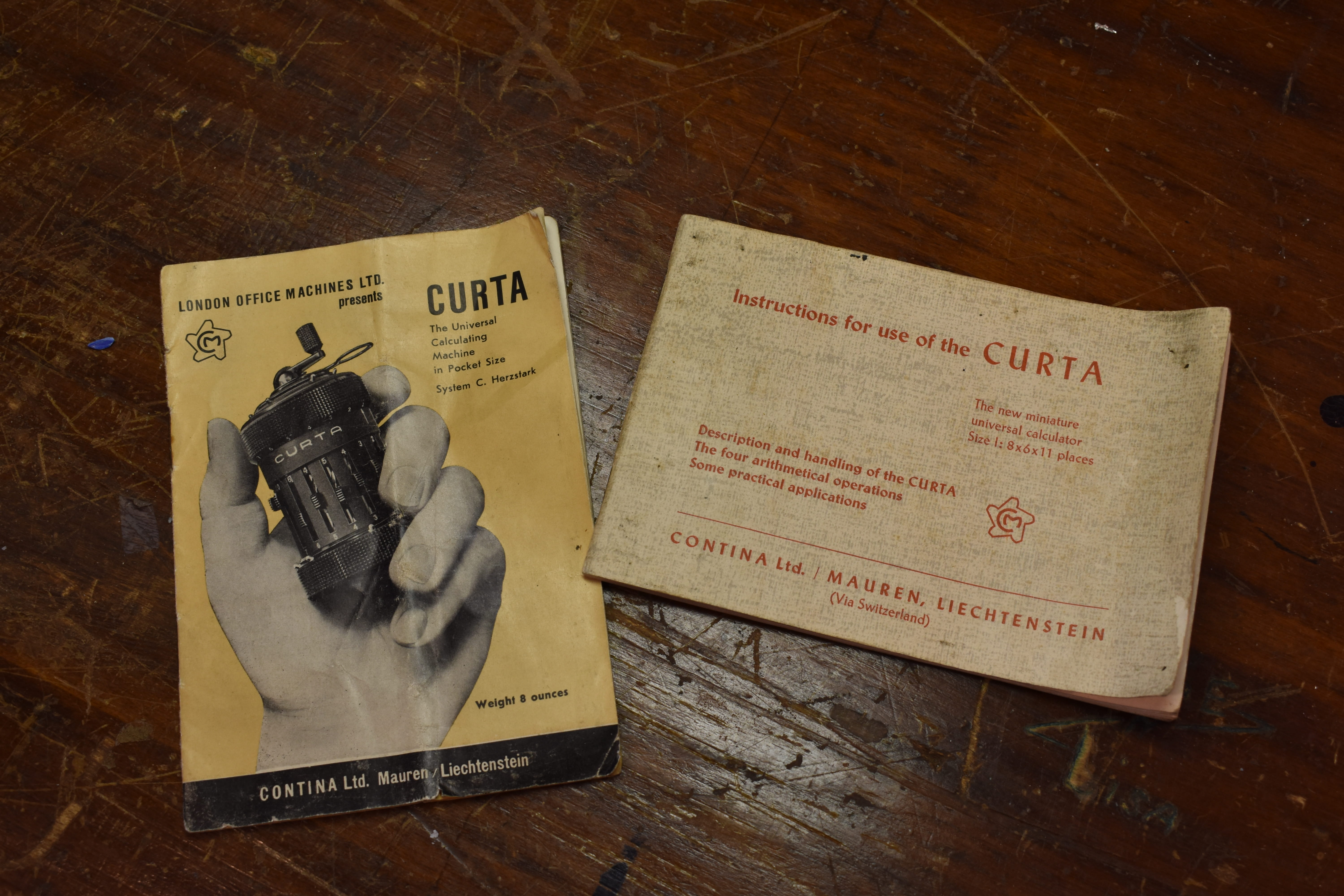
One is a promotional leaflet and information packet for the device. It shows how to hold it, goes over the machine’s advantages, and has some example calculations to get the user started.
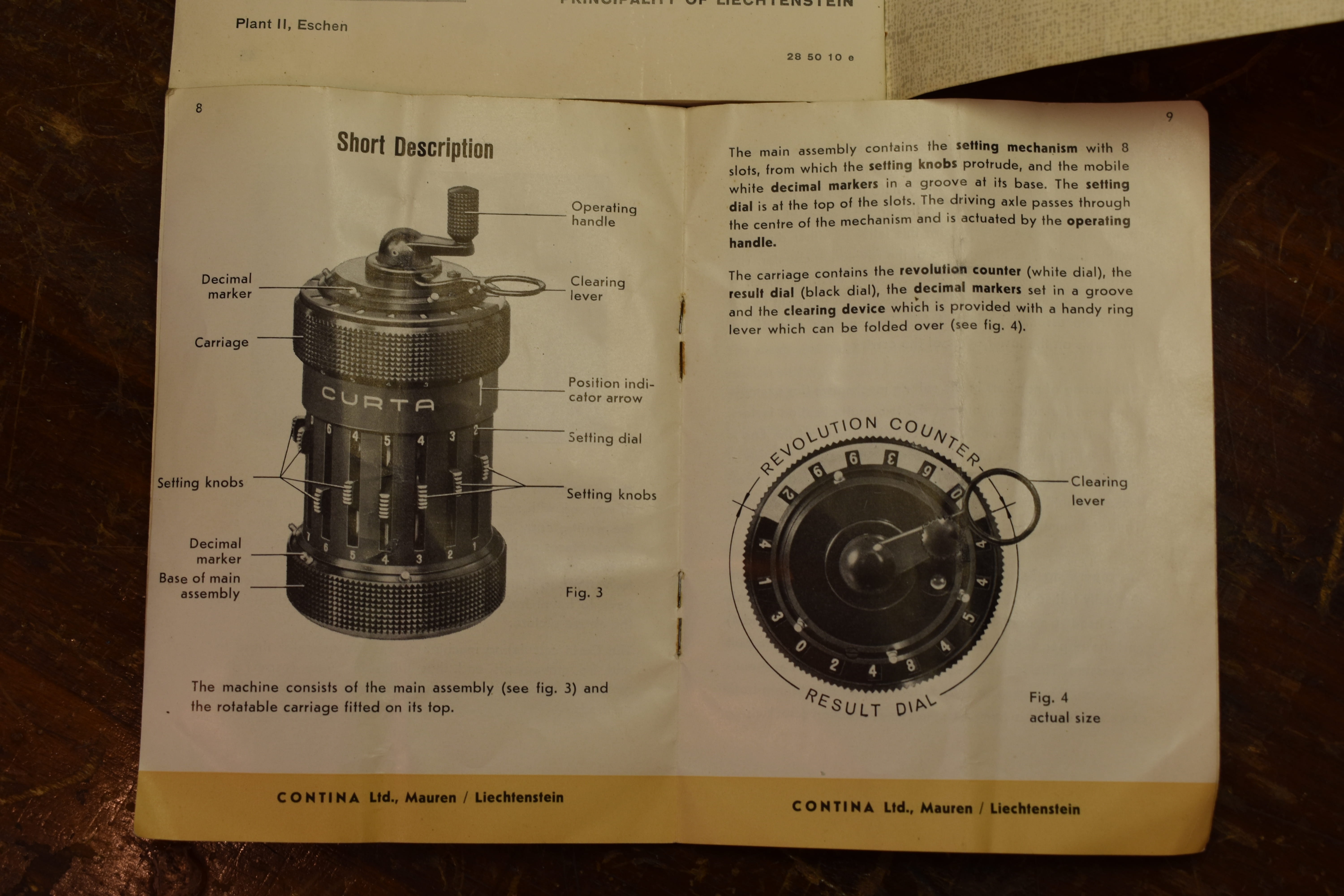
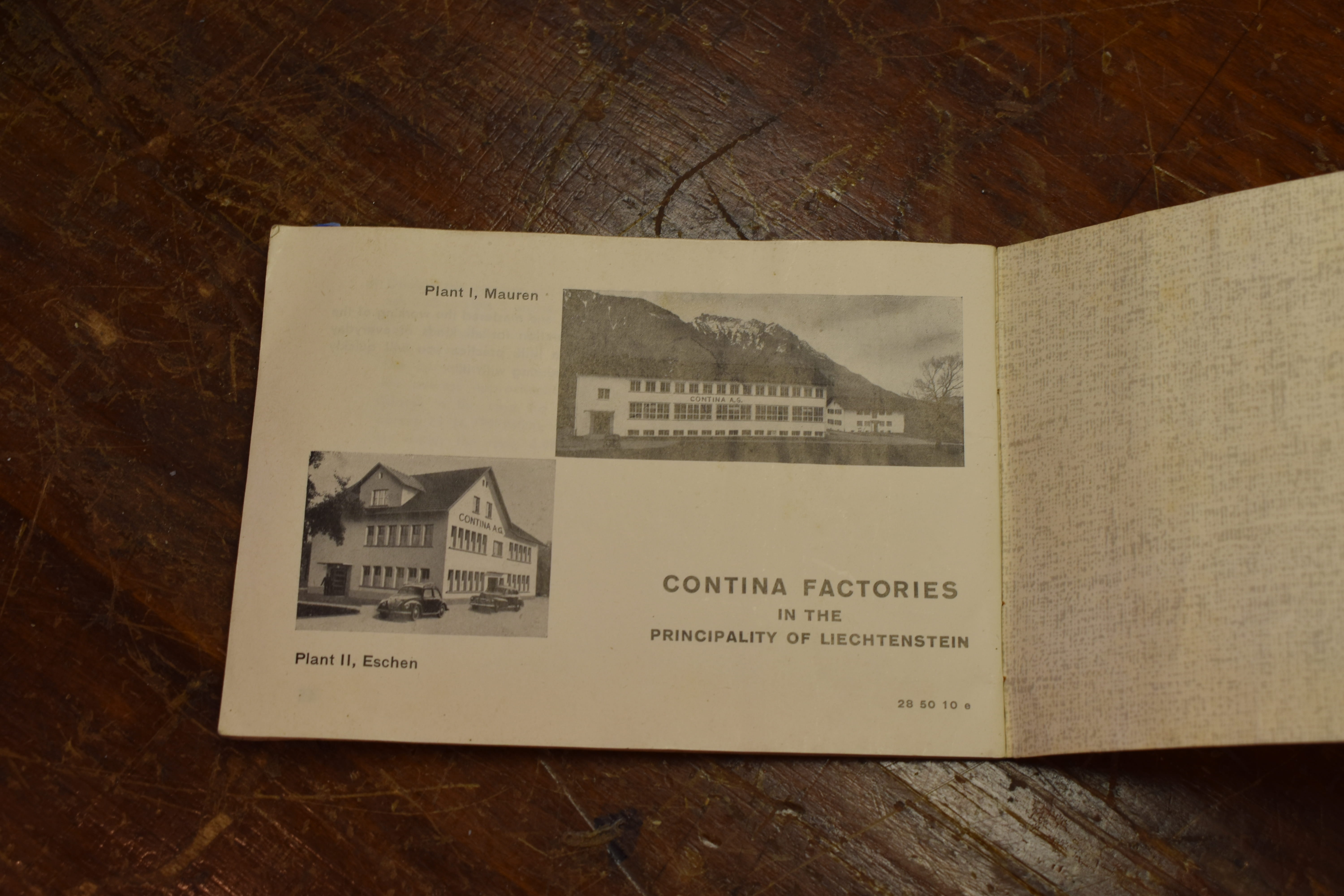
The other instruction manual gives more complex operation instructions for doing calculations on the device. It has instructions for simple additions and percentages as well as instructions for calculating square roots. It also has pictures of the factories in the back.
Mechanism
This Curta was in perfect working condition when I got it, so it has not been taken apart yet. However, the first promotional leaflet has a section dedicated to the mechanism. Here is a scan of those pages from my leaflet:
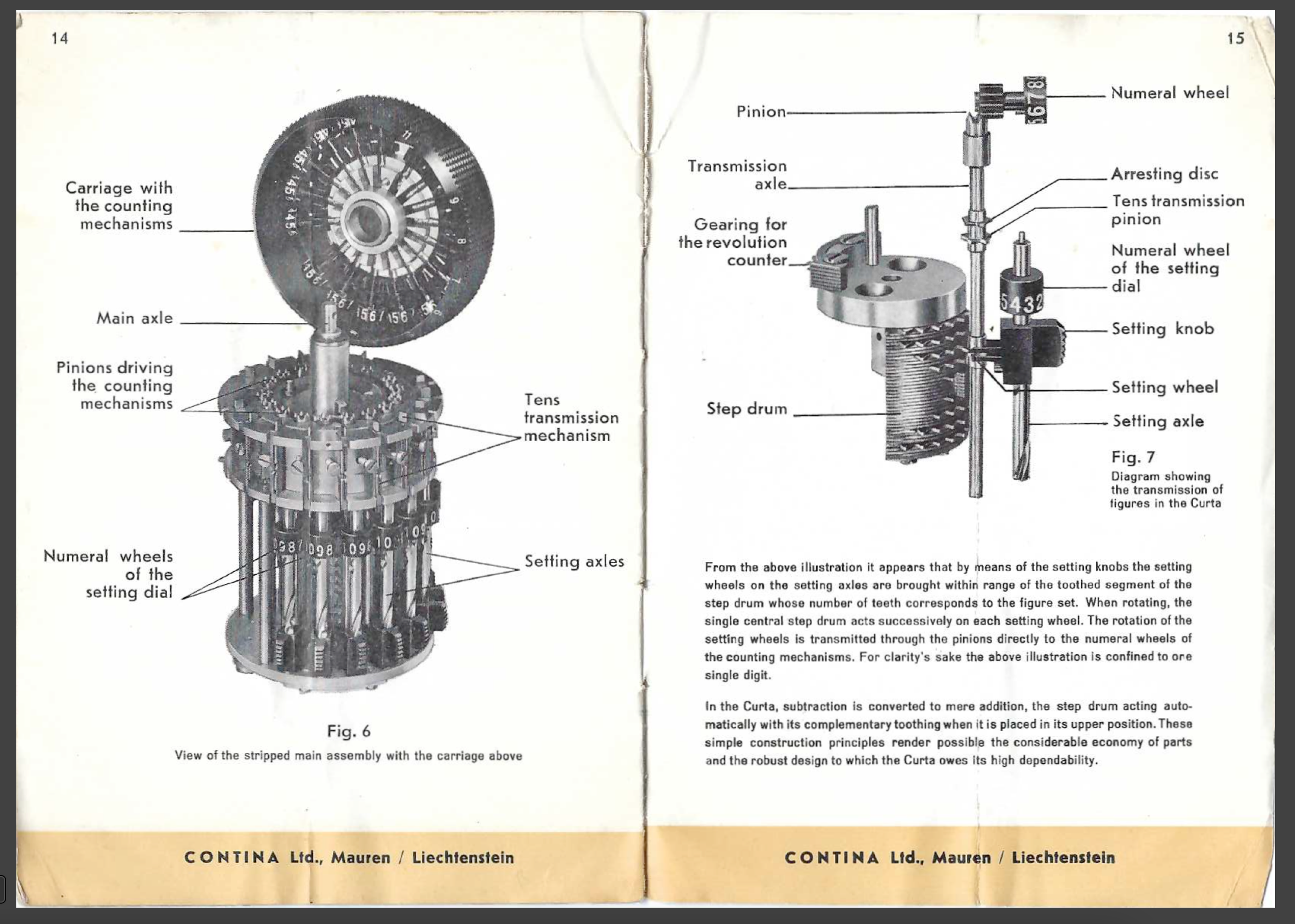
At its core, the Curta uses a series of stepped drum style cylinder portions with teeth of varying lengths arranged along their axis. When a digit is set using the sliders on the side of the device, that determines how many teeth will engage with the corresponding digit wheel in the result register at the top. Turning the crank rotates all the stepped drums simultaneously, and each drum advances its digit wheel by the amount set on that slider. This allows for addition in a single turn of the crank.
Subtraction and multiplication build on this basic mechanism through clever mechanical design. For subtraction, the Curta uses a complementary counting method. By pulling up on the crank before turning, this shifts up the stepped drums and engages the nines’ complement teeth, effectively subtracting instead of adding. Multiplication and division is performed through repeated addition or subtractions as with other hand cranked calculators.